
High Point City Directory Shelves
The strongest starting point is the Heritage Research Center at High Point Public Library. HRC says its printed High Point city-directory collection runs from 1910 to the present. The city history identifies 1908 as the first High Point directory, so 1908 and the HRC shelf describe related but not identical availability claims. Selected editions are also discoverable through DigitalNC, while a later library/database coverage list identifies runs from 1927 to 1935, 1937 to 1940, and 1942 to 1960. Those later ranges need a catalog or volume check before an absent year is treated as a gap.
| Collection | Years | Where | Access |
|---|---|---|---|
| First High Point directory noted by city history | 1908 | City-history reference | Confirm the title page or scan before citing an entry. |
| Printed High Point directory collection | 1910-present | Heritage Research Center | Physical reference collection; check the catalog for a particular volume. |
| Identified digitized editions | 1910-11, 1913, 1916-17, 1919, 1921-27 | DigitalNC and related library records | Selected online discovery, with edition-level verification needed. |
| Later database-listed runs | 1927-35, 1937-40, 1942-60 | Library/database coverage list | Access and annual completeness were not verified from official volume records. |
Publishers were not identified in the official sources inspected. Use a neutral citation such as “High Point directory, 1919” until the title page is in hand. A directory year can also be gathered before printing, so it may record a business address, a residence, an owner, a renter, or someone who had already moved.
High Point Directory Research Desk
HRC is at 901 N. Main Street, High Point, NC 27262. Its posted contact is 336-883-3637 and ncroom@highpointnc.gov. Posted hours are Monday 9 a.m. to 6 p.m.; Tuesday through Thursday 9 a.m. to 8 p.m.; Friday 9 a.m. to 6 p.m.; Saturday 9 a.m. to 1 p.m. and 2 p.m. to 6 p.m.; and Sunday closed. Hours can change, so verify them before a special trip. The center is also a FamilySearch affiliate and links research databases whose access conditions can depend on an in-library visit or a library account.
Heritage Research Center
Printed directories, yearbooks, vertical files, genealogy guides, and local newspaper microfilm.
336-883-3637
High Point Museum
Artifacts, photographs, and archival records that add context to names, streets, businesses, and neighborhoods.
336-885-1859
The HRC local-history page documents the directory holdings alongside the obituary index, vertical files, yearbooks, and newspapers. It is a practical in-person fallback when a digitized volume will not open or an entry must be inspected on the page.
The Heritage Research Center source page shows the local-directory research setting.
The library setting matters because staff-assisted obituary-index searches, physical volumes, and microfilm can answer questions that a single online listing cannot.
High Point Digital Directory Scans
Digitization expanded local discovery after High Point Museum and HRC began working with UNC’s NC Digital Heritage Center in 2014. One specifically identified record is “High Point, N.C. City Directory 1910-1911,” DigitalNC record 25276. The item page returned an access error during the source inspection. That means its image count, page sequence, and the fields on any individual entry were not confirmed. Treat the record as a route to investigate, not as proof of what a particular page says.
The DigitalNC record for the 1910-1911 High Point directory is the source behind this capture.
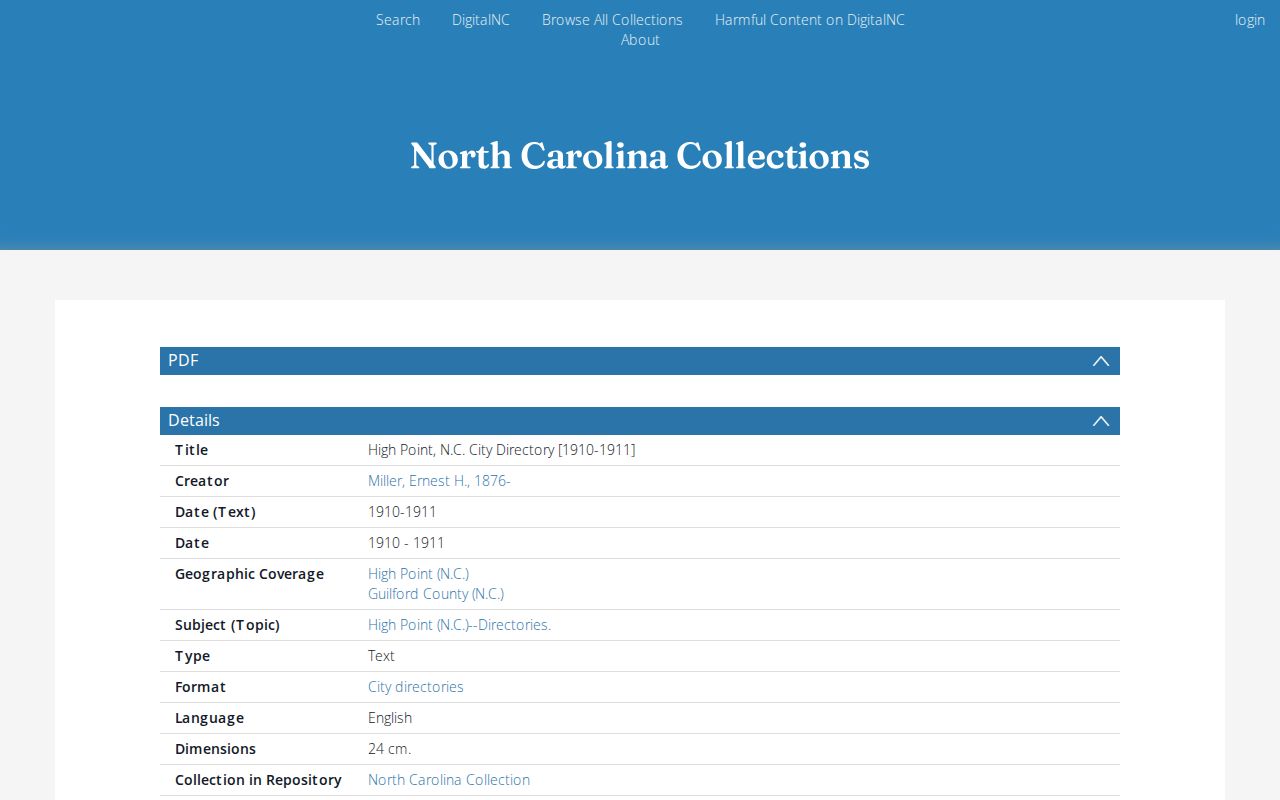
When the scan is available, record the volume title, publication year, page number, and the URL before copying a name or address into research notes.
Reading a High Point City Directory Entry
Do not assume every High Point city directory uses the same layout. The actual entry image was unavailable during research, so the fields below are a careful inventory of what local directory conventions may print and what should be checked in the specific volume. An entry can identify a person but still leave uncertainty about whether the address was residential, commercial, current at publication, or associated with another household member.
| Name and spelling | Capture the name exactly, including initials, punctuation, and any alternate spelling. |
|---|---|
| Relationship notation | A spouse or other household relationship may appear in parentheses where the volume prints it. |
| Occupation and firm | Occupation, business description, or employer may be printed. Preserve the wording rather than modernizing it. |
| Street line | Record the house number and street, then compare it with the street section if the volume has one. |
| Status marks | Owner, renter, or widow notation is useful only when that edition’s key confirms the mark. |
| Volume context | Keep the directory year, page, abbreviation-key meaning, and nearby names or businesses with the entry. |
- Criss-cross directory
- An address-ordered directory section that may list occupants or businesses by street. No named High Point run was verified in the official sources, so ask HRC whether a given volume includes one.
- Householder index
- A name index organized around heads of households or addresses. Its exact form varies by publisher and edition.
- Abbreviation key
- The volume’s own explanation of shortened terms and symbols. Photograph or transcribe it before interpreting marks beside a name.
Note: Ask HRC specifically about reverse, criss-cross, or street-address volumes instead of assuming every directory includes one.
High Point City Directories Beside Census Years
Directories work best between census releases. Federal census access follows a 72-year release rule, and 1950 is the latest generally released census. A 1940 directory, the 1940 census, and a 1941 deed answer three different date questions. A directory may suggest a move, while the census can show the household at the census date and the deed can document a property transaction. Do not merge those dates into one conclusion.
- Start with the known name, street, or house number and note likely spelling variants.
- Check the HRC shelf and DigitalNC for nearby directory years, recording title, year, page, and abbreviations.
- Compare the name across editions. A change of address is a lead, not automatic proof of a sale or a move date.
- Place a census year beside the directory years and compare the household, age pattern, and address carefully.
- Use a deed, parcel record, obituary, or original newspaper issue to resolve a conflict or a disappearance.
The High Point Enterprise microfilm begins in 1886, although the run before 1915 is incomplete. HRC staff can search the Enterprise obituary and death index on request. A hit should be checked against the original issue or scan, with its date and page saved in the research file.
High Point Records Beyond the Book
One directory volume rarely answers a household question alone. HRC keeps vertical files for businesses, churches, city government, education, manufacturers, neighborhoods, parks, racial integration, schools, and streets. Its yearbook holdings include High Point Central, High Point High, Southwest Guilford, T. Wingate Andrews, Wesleyan Christian Academy, Westchester Academy, and William Penn High School. Yearbooks can place someone in a class, organization, or school year, but they do not prove a current address.
HRC also holds National Register nomination files for places including Blair School, Deep River Friends Meeting and Cemetery, the Haley House, the Kilby Hotel, the Tomlinson Chair Manufacturing Complex, and William Penn High School. Historic-district files include Johnson Street, Oakwood, and Sherrod Park. These materials can explain the setting around a name or street, but they should not replace a dated directory listing, parcel record, or recorded instrument.
The High Point Museum online collection holds more than 37,000 selected artifacts, photographs, and archival-collection records. It is a growing research collection rather than a complete resident list. Use an object caption to understand a factory, street, institution, or neighborhood, then keep the directory or deed as the source for a person-and-address claim.
For a record that falls outside local library holdings, the North Carolina Archives guide to Guilford County material routes researchers to county series and finding aids. It is especially useful when a directory name points toward an estate, court, marriage, naturalization, or local-government record rather than a city listing.
High Point Local Record Timeline
The local chronology explains why a single online search is not enough. The city history credits the first directory to 1908, HRC begins its printed holding at 1910, and a digitization partnership began in 2014. These are collection milestones, not a claim that every year has survived online.
- 1896: J. J. Farriss began local booklets that connect Enterprise editing, people, manufacturing, factories, and street photographs.
- 1908: City history identifies the first High Point directory.
- 1910-present: HRC reports printed High Point directory volumes in its collection.
- 2014: HRC and the museum began work with the NC Digital Heritage Center to digitize local historical material.
Use the High Point history collection for local record context and HRC for a particular directory volume. This division keeps a history statement from being mistaken for a scanned entry.
Trace Families With High Point City Directories
For family history, start with the first confirmed appearance, then work forward and backward through nearby editions. Search surname fragments, initials, middle names, married or former names, estate names, and business suffixes. A household that disappears may have moved, died, changed its spelling, been omitted, or shifted to a different kind of listing. Compare an obituary index, a deed or parcel record, and a census schedule before choosing among those explanations.
When a street is the central question, the current parcel and address tools deserve their own review in the High Point street directory. For an older household, preserve the original neighborhood, school, business, or street wording beside each entry. High Point reaches into four counties, so a postal city line alone does not establish which county holds the related parcel or court record.
Note: Use directory information for personal historical and family research, and never use a name or address to harass, stalk, or harm someone.