
High Point Resident Lookup Records
One name can turn up in several different High Point record systems, but each system answers a narrower question. The first jurisdiction check matters because High Point extends into Guilford, Davidson, Forsyth, and Randolph Counties. A Guilford result is useful only after the address, parcel, or court location points there. The table separates evidence of ownership, registration, a legal event, and a historical appearance so a resident lookup does not turn a partial match into an identity claim.
| Record | What It Confirms | Where | Access |
|---|---|---|---|
| Parcel card | Listed owner, situs, mailing address, parcel identifiers | Guilford Real Property Listing | Free current search |
| GIS | Parcel geometry, city limits, county, ZIP, and ETJ context | Guilford GIS Data Viewer | Free map service |
| Voter record | Public registration details, precinct, status, and history | NC Voter Lookup | Free name search |
| eCourts | Public case role, location, type, status, and events | NC eCourts Portal | Free public summary |
| Civil process | Service event, docket, type, status, and dates | Guilford Civil Process Lookup | Free current search |
| Vital record | Recorded birth, death, marriage, divorce, or fetal-death event | NC Vital Records | Certificates controlled |
| Deed index | Conveyance parties and property legal description | Guilford Register of Deeds | Index and office route |
| Directory and obituary sources | A person or household in a particular historical period | Heritage Research Center | Library and staff route |
Use the record that fits the question already known. A current owner search begins with the parcel portal; a public registration question begins with the voter form; a historical household question may begin with the library. A mailing address is a tax-correspondence clue, not proof that an owner lives at the parcel. Likewise, a case party is not automatically a High Point resident.
High Point Voter Lookup Fields
The state Voter Lookup requires a first name, last name, and at least one status choice. Middle initial, year of birth, and county are optional filters. For a common name, begin with the required fields, then add Guilford only after confirming the address county. Compare any returned address, precinct, districts, party, registration status, and participation history with a parcel or GIS result. Participation history records an election event, not a ballot choice.
The official NC Voter Lookup form illustrates the name, year, county, and status controls used for a High Point resident lookup.
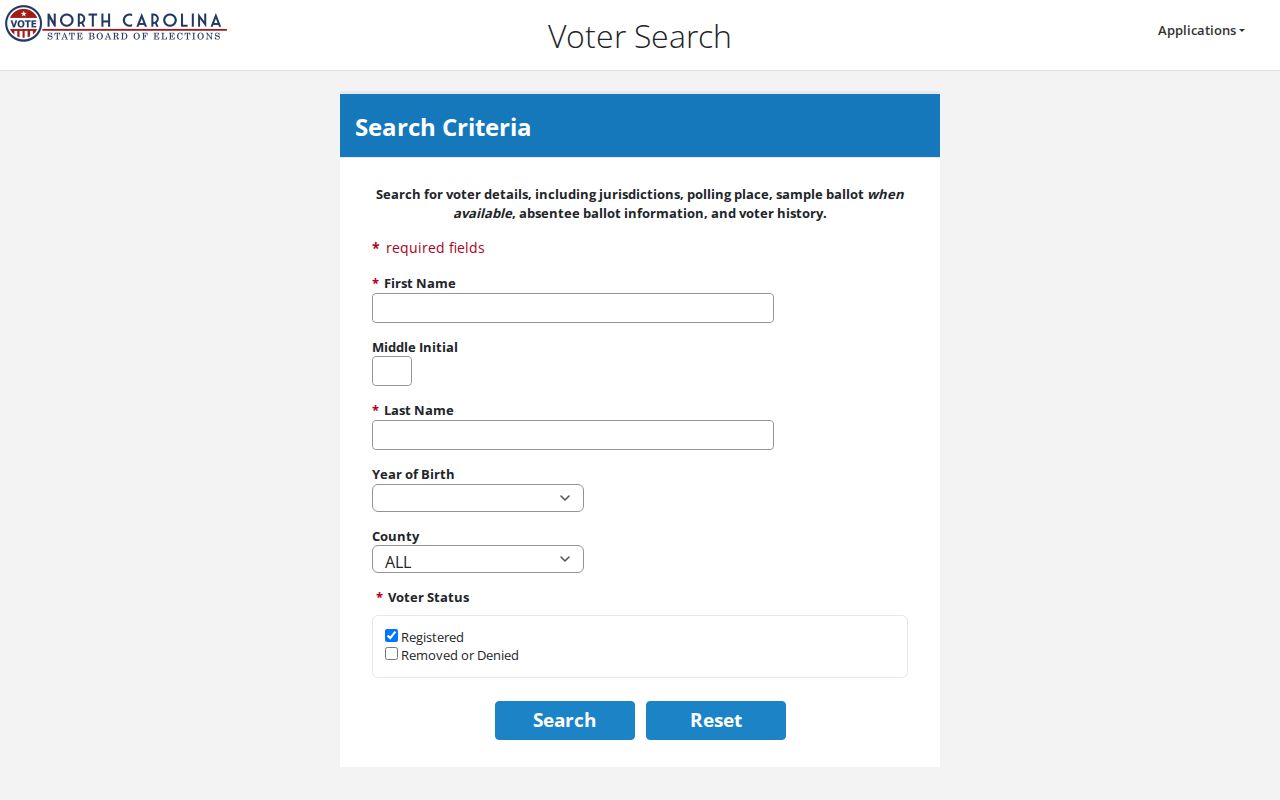
The form's required status control is easy to miss. A non-match only says that the submitted combination returned nothing, so spelling variants, a middle initial, county, year, and the selected status deserve a careful retry before a search is set aside.
North Carolina withholds full date of birth, Social Security number, driver-license or agency identity, email, photo-ID copies, and protected addresses under G.S. 163-82.10. The public web tool is name-first, not a browseable street list. A lawful county or precinct-file request has a separate statutory route, actual-cost rule, and use restrictions.
Note: Registration supports a dated public-address connection, not ownership or physical presence on a particular day.
High Point eCourts Name Search
North Carolina's statewide eCourts Portal uses Smart Search for a party name or case number. For a name search, the Judicial Branch guide calls for a surname of at least three characters followed by *, and a first name of at least one character followed by *. A case-number search uses at least four characters plus the wildcard. Advanced filters can narrow location or county, party criteria, case type, status, and filing-date range.
| Portal field | Useful High Point practice |
|---|---|
| Party name | Try a surname fragment with *, then a known first-name fragment. |
| Case number | Use the known case number with four or more characters and *. |
| Location and county | Use after confirming the case belongs in Guilford or another High Point county. |
| Case filters | Narrow by type, status, or filing-date range instead of assuming a name hit is unique. |
The public Smart Search screen is the starting point for court-related resident lookup work.
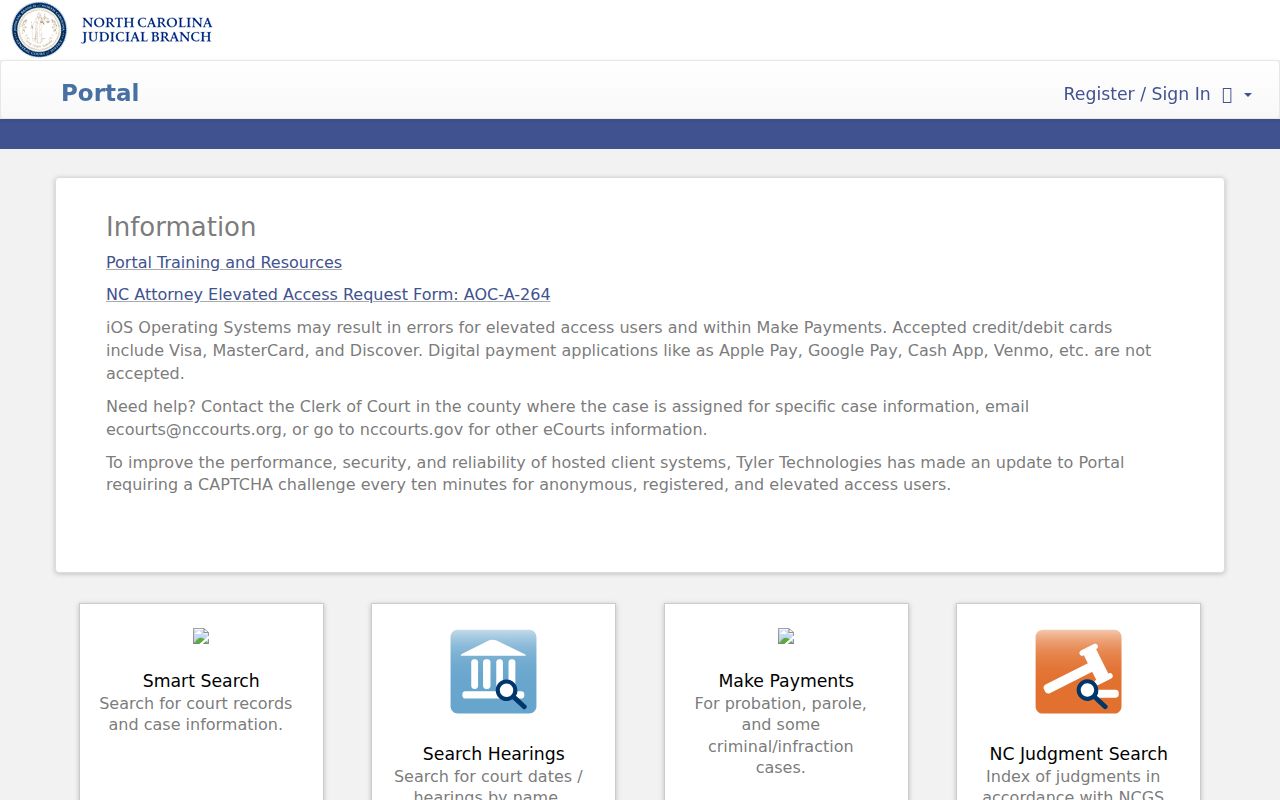
A public result can show case number, court location, type, status, filing or index date, party and role, events, disposition, judgment comments, and financial information when public. It is a case summary or register of actions, not a promise that every filing image is online.
High Point Civil Process Clues
Guilford's Civil Process Lookup permits searches by person or business name, docket number, or street number and street name. A returned row can supply a received date, service type, status, disposition date, and docket reference. That makes it a focused way to identify a dated service record, not a directory of people who live at an address.
The civil-process search shows the name, docket, and address paths that may support a High Point resident lookup.
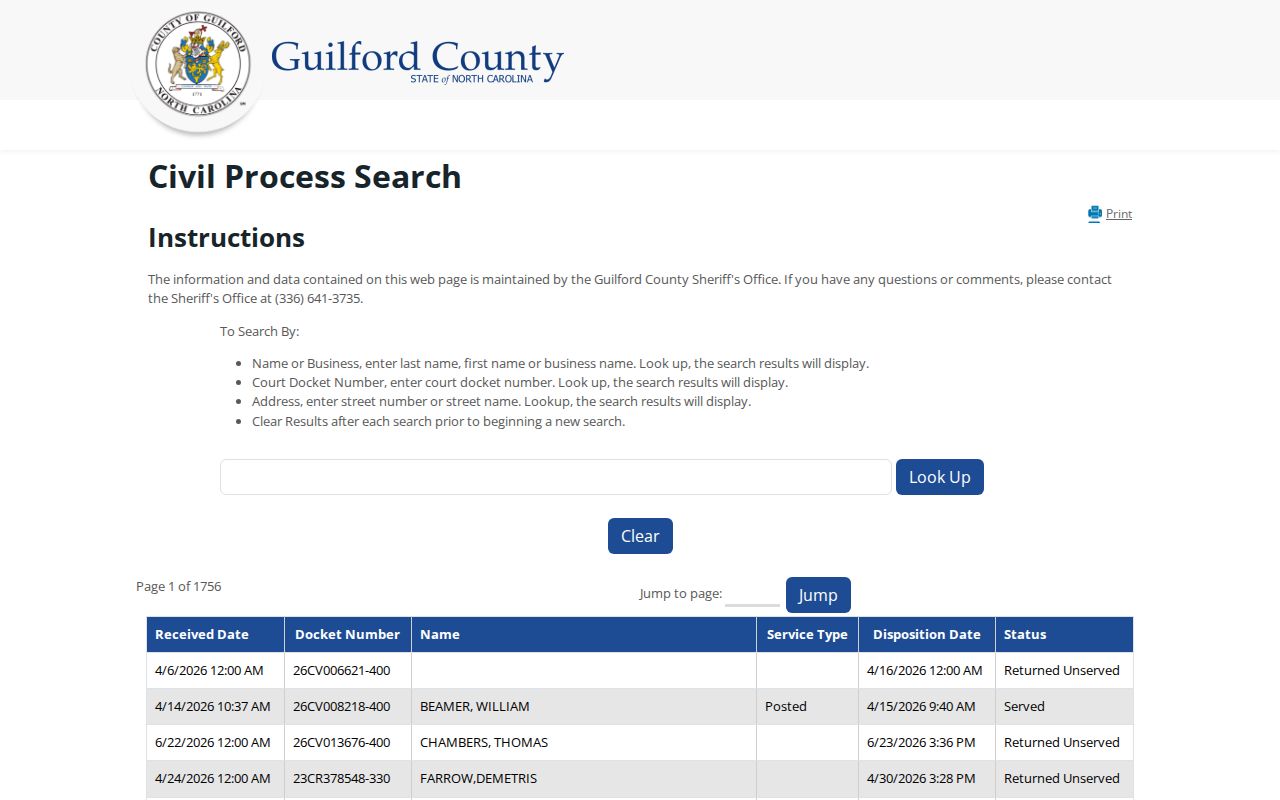
Service can occur at a business, old address, or other location connected to a case. Pair the event date and docket with a separate current record before using it as an identity check. A process result that does not fit the date or county is a reason to reject the match.
Verify a High Point Resident
Verification works best as a short chain. Keep the name spelling, record date, county, and source type beside each result. High Point's four-county footprint makes a city name alone weak evidence. Parcel geometry and the city-limit layer can show which county should hold the tax, voter, deed, or court record before any name is treated as a match.
- Start with a public parcel or voter record that fits the known name and address. Record the situs and mailing addresses separately.
- Search eCourts for surname, initials, and known variants. Compare party role, filing date, and court location rather than relying on a name alone.
- Use an obituary, directory entry, deed legal description, or vital-event route to cross-check a second independent detail. For a court matter, retain the docket number.
- When proof rather than a lead is needed, ask the original custodian for the exact public image, copy, or certificate allowed by its rules.
- Docket
- The court's numbered case record, which tracks parties, events, filings, and dispositions.
- Index versus image
- An index is a searchable entry or summary. An image is the underlying recorded page or document when the custodian makes it available.
- Certified copy
- A copy authenticated by the custodian. Availability, eligibility, and fees depend on the record type.
Do not ask clerk staff to decide whether two same-name people are the same person. Give the case number, year, record type, and precise request instead. Public courthouse computers offer free non-certified statewide case searching, and the High Point courthouse is at 505 E. Green Drive, with the clerk reachable at 336-822-6700.
High Point Vital Record Routes
NC Vital Records lists births from 1913, deaths from 1930 with some delayed records back to 1909, marriages from 1962, and divorces from 1958. Those dates describe office coverage, not a public name index or universal certificate access. For earlier events, route births to the Register of Deeds, deaths to the State Archives, marriages to the office where the license was issued, and divorces to the clerk where filed.
Under G.S. 130A-93 and G.S. 130A-99, access to certified copies is controlled by relationship, identification, legal-rights use, or authorized representation. G.S. 130A-93.1 sets a maximum state search or first-copy charge of $24 and $15 for an additional copy from the same search. The official order path reports a $13.95 VitalChek processing charge, with regular delivery shown as $0 and overnight delivery as $20; confirm the current screen before paying.
The state vital-record order page shows the event choices and the relationship and identification prompts for a High Point resident lookup.
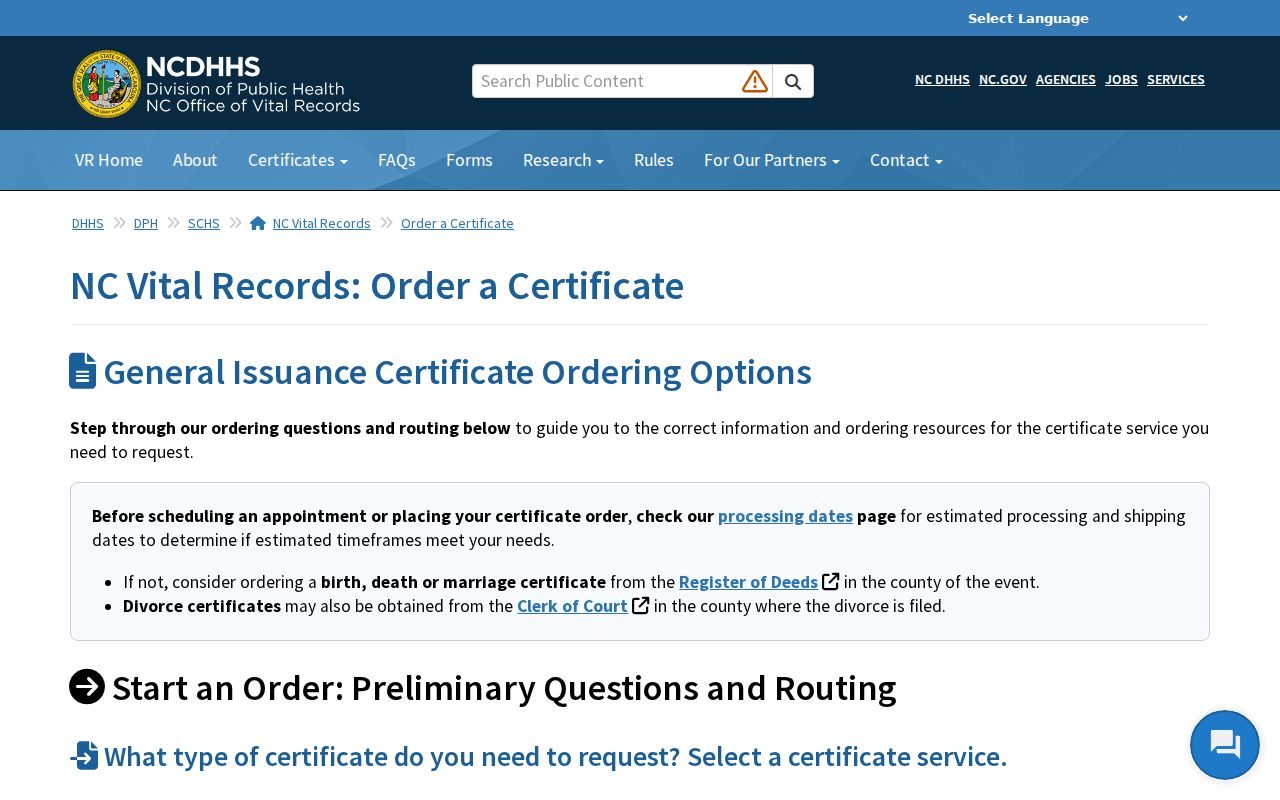
Record the exact event date, place, and requested document type. A docket may show that a divorce case existed, while the certificate and the court file have different custodians and access rules. A paid state search is not always the first genealogical step, because an unlocated search can still carry the statutory fee.
Note: A vital-record clue should be labeled as an index, an uncertified copy, or a certified copy before it is relied on.
High Point Historical Name Clues
The Heritage Research Center holds printed High Point city directories from 1910 to the present, Enterprise microfilm from 1886 with gaps before 1915, an obituary index, yearbooks, and local-history guides. These sources tie a name to a particular year and context, not to a current address. They are especially useful when a court or voter result needs an independent historical check.
For an estate or family question, the State Archives' Guilford widows' year's-support series covers 1894 through 1968 and is indexed from Abels to Zimmerman. The series can supply family and estate context when a modern portal yields only a caption. Preserve the year and source beside every historical name, since spelling, married names, initials, and street labels can shift over time.
High Point Resident Lookup Boundaries
North Carolina's Public Records Law, Chapter 132, provides access to public government records but does not override sealed court files, juvenile matters, federal restrictions, Social Security number controls, or protected voter data. eCourts does not expose sealed, juvenile, protected, or expunged material through the public portal. Register of Deeds records have undergone Social Security number redaction, and those numbers should never be sought or copied.
The North Carolina Address Confidentiality Program uses substitute addresses for eligible survivors of domestic violence, sexual assault, stalking, or human trafficking. Chapter 15C and G.S. 132-1.1 protect that information. A protected address is a stopping point, not a puzzle to solve by combining other records.
High Point Resident Lookup Requests
When a relevant public record is not online, use the City of High Point JustFOIA portal for a narrow Chapter 132 request. The city says a requester need not identify themselves or give a reason. Name the address or record number, date span, record type, and preferred electronic format. A focused request such as a specific permit, inspection report, or correspondence set is easier for the custodian to locate than an open-ended request about a person.
For court, deed, voter, and certificate material, send the request to the actual keeper rather than the city by default. Ask for the public access route, available copy format, and lawful fee before payment. If an index is wrong, report the precise case, instrument, parcel, or voter identifier to the custodian; a researcher cannot edit the underlying government record.